
9 Most Iconic Balinese Masks and What They Represent

Balinese masks are more than decorative works of art. Each face, expression, color, and carved detail can carry a connection to Balinese mythology, traditional performance, spirituality, and cultural identity.
For generations, Balinese artisans have transformed pieces of wood into expressive masks representing gods, legendary characters, protective figures, and powerful forces from traditional stories.
At Wayan’s Shop, our family has been connected with Balinese art in Ubud since 1998. Many of the masks we offer are individually hand-carved and hand-finished, allowing the natural character of the wood and the artisan’s work to remain part of each piece.
Here are nine of the most recognizable figures you may encounter in Balinese mask and wood-carving art.
1. Barong — Protection, Harmony and Balance
Barong is one of the most recognizable figures in Balinese culture. Often depicted as a powerful and expressive creature, Barong is traditionally associated with protection, courage, harmony, and the balance between opposing forces.
The Barong is especially well known through traditional Balinese performances, where his presence is closely connected with stories of the struggle between forces of good and darkness.
Balinese Barong masks can feature elaborate crowns, expressive eyes, prominent teeth, and richly decorated surfaces. The combination of carving and painting gives each mask a distinctive personality.

2. Rangda — Power and Transformation
Rangda is one of the most dramatic figures in Balinese traditional art. Her distinctive appearance often includes wide eyes, long fangs, a protruding tongue, and elaborate hair.
Rangda is traditionally presented in connection with powerful forces and the cosmic balance represented in Balinese stories and performances. Her striking appearance makes Rangda masks immediately recognizable.
For collectors, a hand-carved Rangda mask can be particularly compelling because the character allows artisans to create highly detailed facial features and expressive carving.

3. Bhoma — The Protective Guardian
Bhoma is a powerful protective figure frequently represented with a fierce expression and elaborate ornamentation.
In Balinese art and architecture, Bhoma is often associated with protection. His intense facial expression is not simply intended to appear frightening; it communicates strength and the role of a guardian.
Bhoma masks are particularly interesting to collectors because of their highly detailed carving. Crowns, hair, eyes, teeth, and decorative elements can create a remarkably intricate composition.

4. Garuda — Strength, Devotion and Freedom
Garuda is one of the most important mythical birds in Hindu tradition and has a particularly strong presence in Indonesian and Balinese art.
Often depicted with powerful wings, an elaborate crown, and an expressive face, Garuda represents strength, devotion, courage, and a connection with Lord Vishnu.
Garuda can appear in masks, sculptures, reliefs, and other forms of traditional Indonesian art. The figure's distinctive wings and ornamentation also give woodcarvers an opportunity to create dramatic three-dimensional pieces.

5. Narasimha — Divine Protection and Courage
Narasimha is the lion-headed avatar of Vishnu and is recognized in Hindu tradition as a powerful protector.
His combination of human and lion features creates one of the most dramatic subjects in traditional sculpture and mask art. The expressive eyes, mane, fangs, and strong facial features can be especially striking when translated into hand-carved wood.
In Balinese-inspired art, Narasimha can represent courage, protection, and the restoration of balance.

.
6. Ravana — A Legendary Figure from the Ramayana
Ravana is a major character in the Ramayana and is widely represented throughout South and Southeast Asian art.
In Balinese art, figures from the Ramayana have been interpreted through local artistic traditions for generations. Ravana is often depicted with elaborate crowns, expressive facial features, and intricate ornamentation.
A Ravana mask can therefore be appreciated not only as a decorative object but also as a representation of one of the great narrative traditions that have influenced Balinese performing and visual arts.
7. Vasuki — The Sacred Serpent
Vasuki is a serpent figure from Hindu mythology and is particularly recognizable through his powerful, elongated form and dramatic features.
Serpent imagery has a long presence in Hindu and Southeast Asian artistic traditions. When interpreted by Balinese woodcarvers, the figure can become an expressive combination of mythological symbolism and local craftsmanship.
Vasuki masks are especially distinctive for collectors looking for something beyond the more commonly seen Barong and Rangda designs.

8. Ganesha — Wisdom and the Removal of Obstacles
Ganesha, recognized by his elephant head, is one of the most widely known figures in Hindu art.
He is traditionally associated with wisdom, learning, prosperity, good fortune, and the removal of obstacles. These qualities have made Ganesha a popular subject for sculpture throughout Bali and Indonesia.
Although Ganesha is more commonly represented as a sculpture than a traditional performance mask, his distinctive form is an important part of Balinese Hindu-inspired wood carving.

9. Hanuman — Courage, Loyalty and Devotion
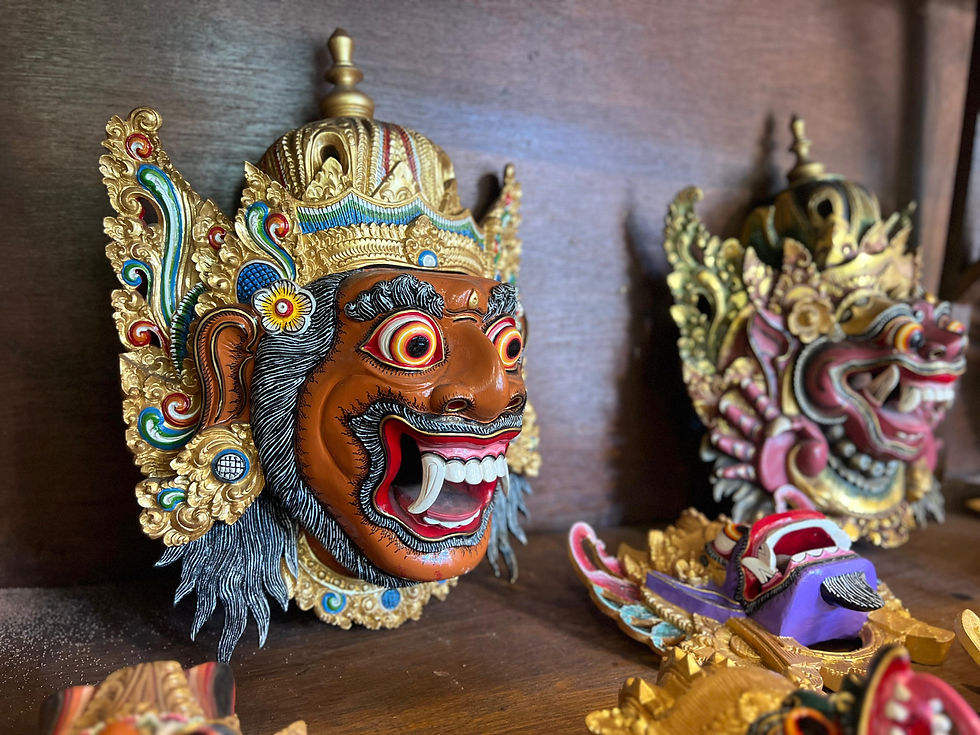
Hanuman is another important character from the Ramayana. Traditionally depicted as a powerful monkey figure, he is strongly associated with courage, loyalty, devotion, and service.
Hanuman has a particularly lively presence in Balinese visual and performing arts. Artists can emphasize his energetic posture, expressive face, elaborate costume, and distinctive monkey features.
A hand-carved Hanuman sculpture can bring together storytelling, craftsmanship, and the visual character of traditional Balinese art.

From a Piece of Wood to a Cultural Work of Art
Traditional Balinese wood carving brings together material, craftsmanship, storytelling, and cultural influence.
A finished mask may begin as an ordinary piece of wood, but through carving and finishing, an artisan gives it a recognizable face and character. The process requires patience and attention to details that can easily be overlooked when viewing the finished piece from a distance.
At Wayan’s Shop in Ubud, we enjoy sharing these pieces with people who appreciate not only their appearance but also the stories and craftsmanship behind them.
Explore Balinese Art from Wayan’s Shop
Our collection includes hand-carved Balinese masks, wooden sculptures, traditional figures, and other works of Indonesian art.
Each piece has its own character, and availability can change as pieces are sold from our physical shop in Ubud.
If you see something that interests you, feel free to contact us before ordering. We are happy to provide additional photos, measurements, details about the piece, and current availability.


Comments